No Hometown, No Problem
On growing up everywhere — and learning to read the room

I don’t have a hometown.
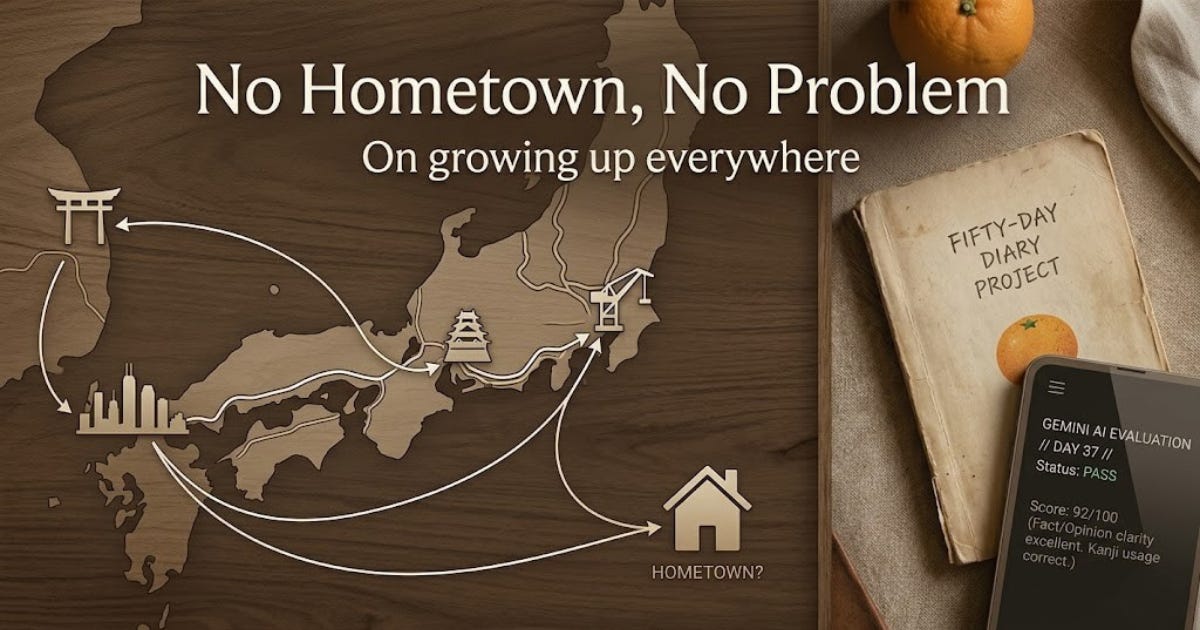
Inage, Houston, Nagoya, Yokohama. Every few years, my father’s job transfer dropped us into a new city — sometimes a new country — and I had to start over from scratch.
“That must have been so hard,” people tell me. Usually the ones who grew up in the same small town their whole lives, went to school with the same kids from kindergarten through high school, and still live twenty minutes from where they were born. In Japan, that’s not unusual. Roots run deep.
But honestly? It wasn’t hard. Not for me.
If anything, I looked forward to it. Where are we going next? There was something freeing about knowing that whatever social mess I’d landed in — the wrong friend group, the wrong reputation, the wrong everything — would reset in a few years. I could always start over.
What I didn’t realize until much later was what all that starting over was quietly teaching me.
Every new city had its own rules. Not written ones. The invisible kind.
Who was in charge. How the social dynamics worked. What you had to do — or pretend to do — to be accepted. I got good at reading those patterns fast. Not because I was particularly clever, but because I had no other choice. I had no history in these places. No built-in belonging. So I watched. I figured out the structure. Then I moved accordingly.
Somewhere along the way, I started seeing the whole world this way.
Life is a game. Every situation has rules. Learn the rules, and you can navigate anything.
That became my operating system.
For a long time, I didn’t know where it came from.
My father left for work every morning with a sigh so heavy you could feel it across the breakfast table.
Even as a kid, I understood what it meant: work is something you endure, not something you choose. You do it for the family. You don’t have to like it.
My mother’s version of this was money. It was always in the background of our home — as a source of worry, of resentment, of quiet desperation. We can’t afford that. Your father doesn’t know how to manage money. I’d leave if I could, but how would I survive?
I paid for my own cram school in high school. I took out student loans for university. And somewhere in those years, I picked up a belief I would carry for decades like armor:
A woman must be able to support herself. Financially. Independently. No exceptions.
So I armed myself. I read economics magazines in college. Started investing. Studied how the pension and social insurance system worked — the fine print most people ignore. Became a certified financial planner. My first job out of university was translating semiconductor patents. Then I passed the national civil service exam and joined a government ministry.
One layer of armor at a time.
And it worked. When we moved to the countryside and my income collapsed, I stayed afloat. When COVID hit and freelance work dried up, I didn’t drown.
But there was always this low-grade anxiety underneath everything. Like running with a bucket that had a hole in the bottom — no matter how much I poured in, it never felt full.
I didn’t understand why. Not for a long time.
Then I had kids.
One day, I asked my daughter: “What does money make you think of?”
She looked at me like it was a strange question. “I don’t know... fun things?”
That was it. That was the moment I understood.
I had inherited a heavy, cold baton from my parents — fear of money, resignation about work, a bone-deep sense that the world is not a safe place to trust. And without realizing it, I had been running with that baton my whole life.
The armor wasn’t strength. It was a response to feeling unsafe.
Once I saw that clearly, something shifted.
If I’d absorbed all of this from my environment growing up — without anyone sitting me down and explaining it — then the opposite was also true. I could build a different environment. For my kids. And maybe, quietly, for myself.
That’s how the fifty-day diary project began.
I set up a system: Gemini — the AI — as an impartial judge. The kids would write daily entries. Gemini would score them. No parental emotion involved, no gold stars for effort, no guilt trips. Just: did you separate fact from opinion? Did you use the kanji you’ve already learned? PASS or FAIL.
I thought I was designing a training system for them.
It turned out to be something else entirely.
It became a mirror.
What kind of environment did I grow up in? What spells did I inherit? And how, slowly, have I been trying to break them?
This article is that record.
One woman, trying to live freely in an irrational world — using the only tools she has: observation, patience, and the willingness to keep questioning.
The rules of the game haven’t changed much since 1977, when a book called Games Mother Never Taught You first put words to something women had always known but never been told directly.
What has changed is how I play.